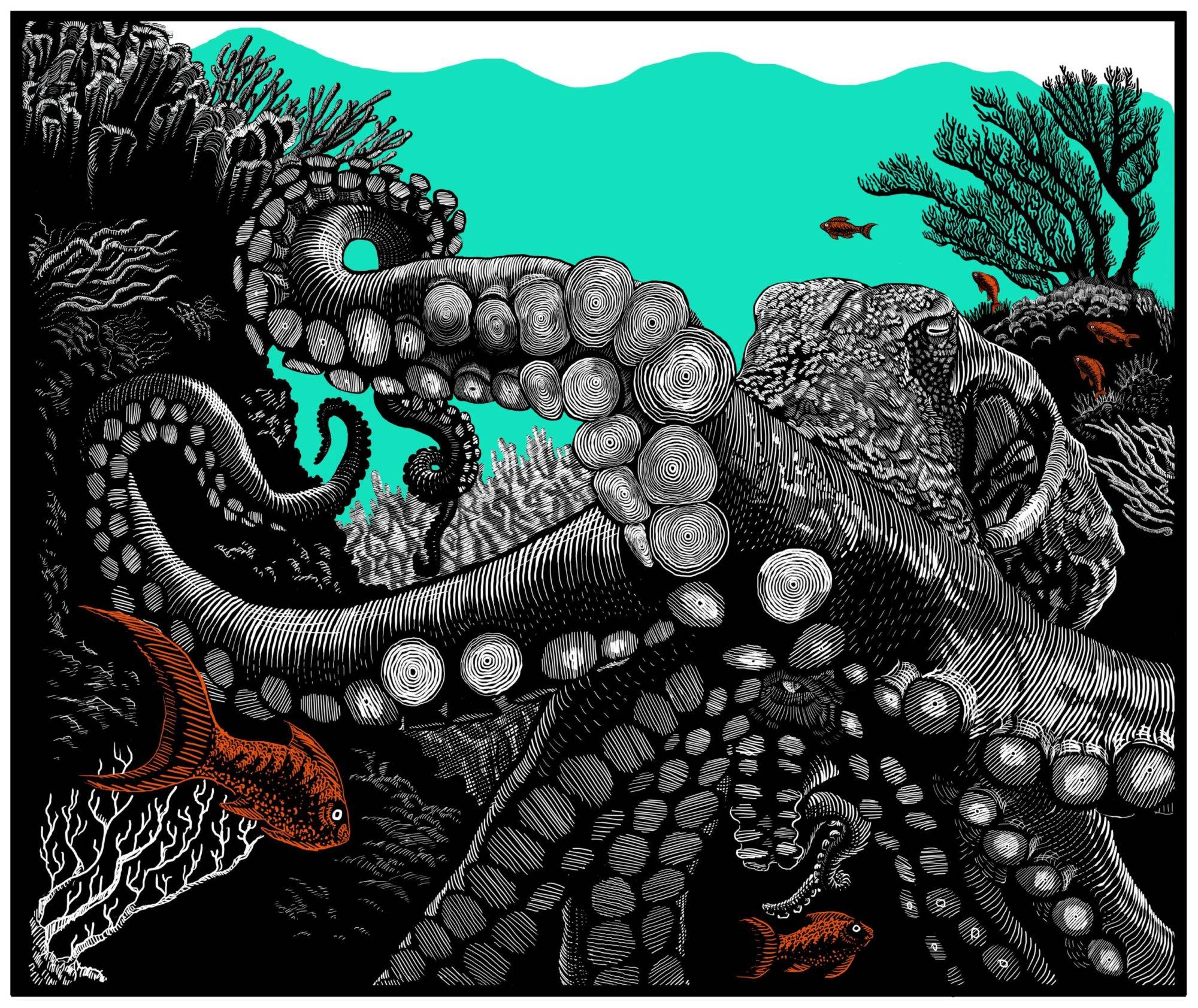

Scratchboard is a medium that has been around since the late 1800’s when English printmakers, looking for an inexpensive way to replicate the visual effect of woodcuts and engravings, did some experimenting and came up with this new medium. It hasn’t changed much since that time.
Scratchboard, or scraperboard as some call it, is a small sheet of illustration board or wood which has a thin layer of white clay applied to its surface and smoothed over. Ink is then applied to the clay surface, either coated over the clay entirely or just in places. You then take a sharp tool like an exacto-blade or one of the specially made scratchboard tools and then scratch off the ink. The end result can look like an engraving, a woodcut, or a simple line drawing. It has been a standard tool of illustrators for over a century now, but in the past 30 years has seen a growing interest by artists interested in seeing how far they can stretch the medium. Illustrators like Mark Summers, Douglas Smith, and Scott McKowen have taken a simple medium and created amazing works of illustration art.


Scratchboard is a medium which has been around since the late 1800’s when English printmakers, looking for an inexpensive way to replicate the visual effect of woodcuts and engravings, did some experimenting and came up with this new medium. It hasn’t changed much since that time.
Scratchboard, or scraperboard as some call it, is a small sheet of illustration board or wood which has a thin layer of white clay applied to its surface and smoothed over. Ink is then applied to the clay surface, either coated over the clay entirely or just in places. You then take a sharp tool like an exacto-blade or one of the specially made scratchboard tools and then scratch off the ink. The end result can look like an engraving, a woodcut, or a simple line drawing. It has been a standard tool of illustrators for over a century now, but in the past 30 years has seen a growing interest by artists interested in seeing how far they can stretch the medium. Illustrators like Mark Summers, Douglas Smith, and Scott McKowen have taken a simple medium and created amazing works of illustration art.
If you’re more of a Fine Arts illustrator you can also use the clay surface to apply gouache or acrylics and then scratch away portions here and there for white highlights. The medium is quite versatile that way.
The most popular commercial scratchboard for artists is currently Scratchbord™ and Clayboard™, from Ampersand, and comes in various sizes for whatever you need. Canson used to have a very nice scratchboard that came in 18 x 24 sheets, but sadly no longer make it. Esdee still makes the 18 x 24 sheets as well as a scratchpaper for kids, but I wouldn’t personally endorse the scratchpaper since it’s very flimsy and you can’t get the kind of detail that you can with Ampersand or Esdee’s board products.
Scratchboard tools come in a couple of different forms. There’s a kit you can buy at art supply stores that has several different tools; a multi-line tool, a kind of “paintbrush” with wire instead of hair to create textured lines, and a piece of steel wool. Esdee has a similar kit with a number of different cutting blades. Personally I prefer the basic thin line/ thick line blades from Speedball, but go with whatever floats your particular boat. If there is one thing I’d like it would be to have someone come up with a decent multi-line tool. The Ampersand kit has one but the needle tips on it don’t work for me, and the lines are way too fine for what I usually do. Most scratchboard artists I’ve talked to about this have come up with methods of their own to make a good multi-line tool, usually involving a Dremel and whatever piece of flat metal they can find to attach to their pen holder. Anyone with a good idea on this is encouraged to chime in.
Question? Just go to the Contact page and let me know what you need. I’m always happy to have a conversation about Art technique.